Colonization of Greenland
A story of unlikley clashes at the end of the world.
Tools
- QGIS
- Blender
- Illustrator
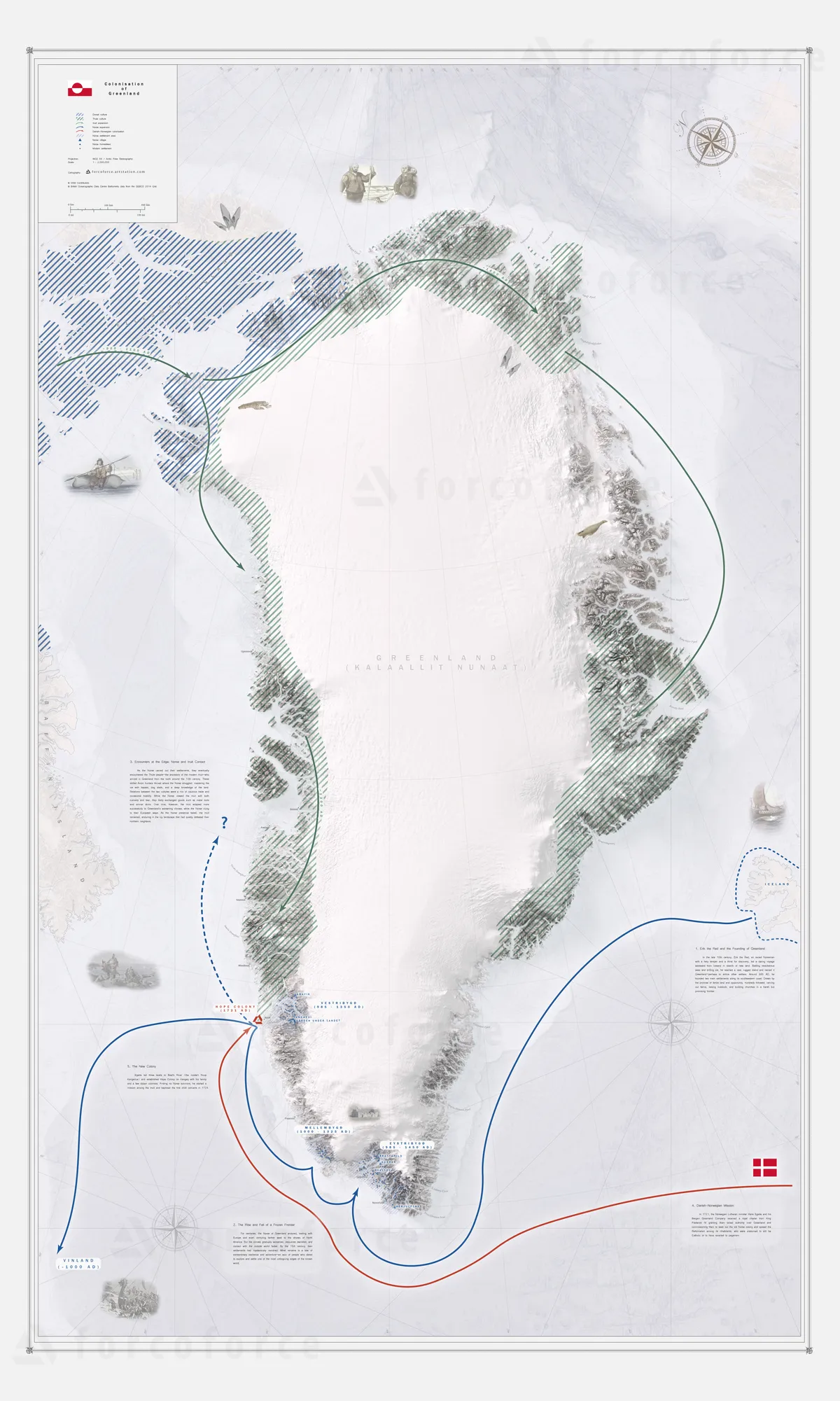
In the late 10th century, Erik the Red, an exiled Norseman with a fiery temper and a thirst for discovery, led a daring voyage westward from Iceland in search of new land. Battling treacherous seas and drifting ice, he reached a vast, rugged island and named it Greenland—perhaps to entice other settlers. Around 985 AD, he founded two main settlements along its southwestern coast. Drawn by the promise of fertile land and opportunity, hundreds followed, carving out farms, raising livestock, and building churches in a harsh but promising frontier.
For centuries, the Norse of Greenland endured, trading with Europe and even venturing farther west to the shores of North America. But the climate gradually worsened, resources dwindled, and contact with the outside world faded. By the 15th century, their settlements had mysteriously vanished. What remains is a tale of extraordinary resilience and adventure—an epic of people who dared to explore and settle one of the most unforgiving edges of the known world.
As the Norse carved out their settlements, they eventually encountered the Thule people—the ancestors of the modern Inuit—who arrived in Greenland from the north around the 13th century. These skilled Arctic hunters thrived where the Norse struggled, mastering the ice with kayaks, dog sleds, and a deep knowledge of the land. Relations between the two cultures were a mix of cautious trade and occasional hostility. While the Norse viewed the Inuit with both curiosity and fear, they likely exchanged goods such as metal tools and animal skins. Over time, however, the Inuit adapted more successfully to Greenland’s worsening climate, while the Norse clung to their European ways. As the Norse presence faded, the Inuit remained, enduring in the icy landscape that had quietly defeated their northern neighbours.
In 1721, the Norwegian Lutheran minister Hans Egede and his Bergen Greenland Company received a royal charter from King Frederick IV granting them broad authority over Greenland and commissioning them to seek out the old Norse colony and spread the Reformation among its inhabitants, who were presumed to still be Catholic or to have reverted to paganism.
Egede led three boats to Baal’s River (the modern Nuup Kangerlua) and established Hope Colony on Kangeq with his family and a few dozen colonists. Finding no Norse survivors, he started a mission among the Inuit and baptized the first child converts in 1724.